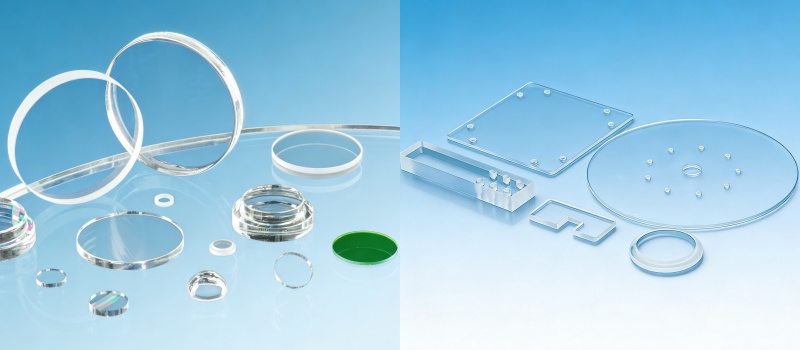
Custom Optical Glass Processing: Precision Cutting, Grinding, Polishing and Machining of Optical Glass
Custom Optical Glass Processing is the manufacturing and precision machining of optical glass and other high-performance glass materials into customized glass components for optical, laser, imaging, instrumentation, electronics, industrial, medical, and scientific applications.
Optical glass is not limited to one specific material. Depending on the application, customers may require optical crown glass, optical flint glass, borosilicate optical glass, fused silica, quartz glass, sapphire, aluminosilicate glass, low-expansion glass, infrared optical glass, UV optical glass, filter glass, colored optical glass, and specialty optical glass.
Different glass materials can be processed into:
● Optical windows
● Optical lenses
● Protective windows
● Camera windows
● Sensor windows
● Laser windows
● Prism blanks
● Filter glass
● Cover glass
● Display glass
● Sapphire windows
● Precision glass plates
● Glass discs
● Glass wafers
● Glass components
● Custom optical glass parts
Jinan JSV Industrial Co., Ltd. provides customized optical glass processing and precision glass machining for international customers, including cutting, grinding, polishing, drilling, CNC machining, edge processing, surface treatment, and other secondary glass processing according to drawings and application requirements.
What Is Optical Glass?
Optical glass is a specialized glass material manufactured with controlled optical and physical properties.
Compared with ordinary architectural or industrial glass, optical glass is selected for applications where properties such as:
● Refractive index
● Abbe number
● Dispersion
● Optical transmission
● Homogeneity
● Birefringence
● Surface quality
● Dimensional accuracy
● Thermal properties
are important.
Optical glass can be used to manufacture or process components for:
● Cameras
● Microscopes
● Telescopes
● Binoculars
● Laser systems
● Optical instruments
● Spectrometers
● Sensors
● Medical instruments
● Machine vision systems
● Scientific instruments
● Defense and aerospace equipment
● Industrial imaging systems
Custom Optical Glass Processing
Different optical applications require different shapes, dimensions, tolerances, and surface finishes.
Custom optical glass processing may include:
Glass Cutting
Glass sheets, plates, and blanks can be cut into customized dimensions.
Precision Grinding
Grinding can be used to achieve accurate dimensions and improve edge quality.
Surface Polishing
Polishing is used where a high-quality optical surface is required.
Edge Grinding
Edges can be processed to remove sharp edges and achieve specified dimensions.
CNC Glass Machining
CNC processing can be used for customized holes, slots, grooves, steps, and complex geometries.
Drilling
Precision holes can be machined according to customer drawings.
Chamfering
Chamfers can be applied to edges according to the required dimensions.
Beveling
Optical and industrial glass components can be beveled for specific applications.
Shaping
Glass blanks can be processed into customized geometric shapes.
Coating
Depending on the material and application, optical glass may be supplied for subsequent or integrated coating processes such as:
● Anti-reflective coating
● High-reflective coating
● Protective coating
● Infrared coating
● UV coating
Types of Optical Glass That Can Be Processed
The optical glass industry includes a large range of materials.
The appropriate material depends on the required:
● Refractive index
● Dispersion
● Transmission range
● Thermal expansion
● Chemical resistance
● Hardness
● Mechanical strength
● Operating temperature
● Optical performance
Common categories include crown glass, flint glass, borosilicate optical glass, fused silica, quartz glass, specialty optical glass, infrared glass, UV glass, and low-expansion optical glass.
Optical Crown Glass
Optical crown glass is a traditional category of optical glass characterized by relatively low dispersion compared with many flint glasses.
Crown glass is widely used in:
● Optical lenses
● Camera systems
● Microscopes
● Binoculars
● Telescopes
● Optical instruments
Examples of commonly encountered optical glass designations include:
● SCHOTT N-BK7
● BK7
● N-BK7
● B270
● B270 Superwite
● K5
● K7
The exact material specification should always be confirmed before production because different manufacturers may use different naming systems or material grades.
BK7 Optical Glass
BK7 is one of the most widely recognized optical glass materials.
SCHOTT’s modern equivalent is commonly known as N-BK7.
BK7-type optical glass is widely used for:
● Optical windows
● Lenses
● Prisms
● Laser optics
● Camera optics
● Optical instruments
● Precision glass components
Customers may search for:
● BK7 Glass
● BK7 Optical Glass
● N-BK7 Optical Glass
● BK7 Optical Window
● BK7 Glass Window
● BK7 Glass Plate
● BK7 Optical Glass Manufacturer
B270 Optical Glass
B270 is another well-known optical glass material used in various optical and industrial applications.
B270-type glass is often considered for:
● Optical windows
● Cover glass
● Instrument glass
● Display applications
● Precision glass components
● Optical filters
Search terms include:
● B270 Optical Glass
● B270 Glass
● B270 Glass Sheet
● B270 Optical Window
● B270 Glass Plate
Optical Flint Glass
Optical flint glass is another major category of optical glass.
Flint glasses generally have higher refractive indices and higher dispersion than traditional crown glasses.
They are commonly used together with crown glasses to design optical systems with controlled chromatic aberration.
Applications include:
● Camera lenses
● Microscope objectives
● Binoculars
● Telescopes
● Optical instruments
● Precision imaging systems
Examples of commonly encountered flint glass designations include:
● F2
● N-F2
● F1
● F5
● SF5
● SF6
● N-SF5
● N-SF6
SCHOTT Optical Glass
SCHOTT is one of the internationally recognized manufacturers of specialty and optical glass.
Common SCHOTT optical glass names and families encountered in optical manufacturing include:
● N-BK7
● N-BK10
● N-FK5
● N-FK51A
● N-K5
● N-K7
● N-F2
● N-FK58
● N-SF5
● N-SF6
● N-SF10
● N-SF11
● N-SK2
● N-SK5
● N-SK11
● N-BAK4
● N-BAF10
● N-LAK8
● N-LAK9
● N-LAK10
● N-LAK14
● N-LAK21
● N-LASF9
● N-LASF31A
The availability of specific grades depends on material sourcing and project requirements.
For projects requiring a particular SCHOTT material, customers should specify the exact grade and optical requirements.
HOYA Optical Glass
HOYA is another major optical glass manufacturer whose materials are widely used in optical systems.
Examples of HOYA optical glass designations that customers may encounter include:
● BSC series
● E-F series
● F series
● FC series
● FCD series
● FDS series
● LA series
● LAF series
● PB series
● TAF series
● TAFD series
Specific material grades should be confirmed according to the required optical properties and the manufacturer’s current material specifications.
Customers may search for:
● HOYA Optical Glass
● HOYA Glass Processing
● HOYA Optical Glass Window
● HOYA Optical Glass Manufacturer
● HOYA Glass Machining
OHARA Optical Glass
OHARA is another internationally recognized optical glass manufacturer.
Customers may encounter OHARA materials such as:
● S-BSL
● S-BK
● S-FPL
● S-FSL
● S-LAH
● S-LAL
● S-LAM
● S-LAH series
● S-FPL51
● S-FPL53
OHARA optical glass is used in various precision optical applications.
For custom processing, the exact OHARA material grade should be specified because optical properties vary significantly between grades.
Corning Optical Glass and Specialty Glass
Corning manufactures a broad range of specialty glasses and glass-ceramic materials used in optical, scientific, electronic, and industrial applications.
Depending on the application, customers may require:
● Fused silica
● Specialty optical glass
● Low-expansion glass
● Aluminosilicate glass
● Specialty cover glass
● High-performance glass
For Corning materials, the exact commercial grade should be provided when requesting custom processing.
Fused Silica and Quartz Optical Glass
Fused silica and quartz glass are widely used in optical applications requiring excellent transmission and thermal performance.
Applications include:
● UV optics
● Laser systems
● Semiconductor equipment
● Spectroscopy
● Scientific instruments
● High-temperature optical windows
● UV lamps
● Photonics
Common search terms include:
● Fused Silica Optical Window
● Fused Silica Glass
● Quartz Optical Glass
● Quartz Optical Window
● UV Quartz Glass
● Fused Quartz Window
● Optical Quartz Plate
● Quartz Glass Window
Sapphire Glass
Sapphire glass, more precisely sapphire / synthetic sapphire, is a crystalline material rather than conventional glass.
It is widely used when excellent:
● Hardness
● Scratch resistance
● Wear resistance
● Optical transmission
● Temperature resistance
are required.
Sapphire can be processed into:
● Sapphire windows
● Sapphire optical windows
● Sapphire sensor windows
● Sapphire camera windows
● Sapphire cover glass
● Sapphire discs
● Sapphire plates
● Sapphire tubes
● Sapphire lenses
Applications include:
● Cameras
● Sensors
● Optical instruments
● Industrial inspection
● Aerospace equipment
● Semiconductor equipment
● High-temperature observation
● Laser systems
Customers may search for:
● Sapphire Optical Window
● Sapphire Glass Window
● Synthetic Sapphire Window
● Sapphire Cover Glass
● Sapphire Camera Window
● Sapphire Sensor Window
● Sapphire Optical Glass
● Custom Sapphire Window
Aluminosilicate Glass
Aluminosilicate glass is a high-performance glass family widely used where improved mechanical strength, thermal performance, and durability are required.
Applications include:
● Protective windows
● Display cover glass
● Industrial equipment
● Optical instruments
● Sensor windows
● Electronic devices
● Automotive applications
● Aerospace applications
Aluminosilicate glass can be processed into:
● Thin glass sheets
● Cover glass
● Optical windows
● Sensor windows
● Precision plates
● Custom glass components
Search keywords include:
● Aluminosilicate Glass
● Aluminosilicate Optical Glass
● Aluminosilicate Glass Sheet
● Aluminosilicate Glass Window
● Aluminosilicate Cover Glass
● High Strength Aluminosilicate Glass
● Chemical Strengthened Aluminosilicate Glass
Chemical Strengthened Glass
Some optical and protective glass components require increased surface strength.
Chemically strengthened glass can provide improved resistance to surface damage and mechanical stress compared with untreated glass.
Applications include:
● Display cover glass
● Sensor windows
● Camera covers
● Industrial control panels
● Electronic equipment
● Mobile devices
● Optical protection windows
Aluminosilicate glass is commonly used as a substrate for chemical strengthening.
Borosilicate Optical Glass
Borosilicate glass can also be used for optical windows and precision glass components where thermal and chemical resistance are important.
Applications include:
● Laboratory optical windows
● Industrial observation windows
● Laser systems
● Scientific equipment
● High-temperature equipment
● Instrumentation
Common searches include:
● Borosilicate Optical Glass
● Borosilicate Optical Window
● Borosilicate Glass Window
● High Borosilicate Optical Glass
● Borosilicate Precision Glass
Low Expansion Optical Glass
Some optical systems require glass with very low thermal expansion.
Low-expansion glass materials can help reduce dimensional changes caused by temperature variation.
Applications include:
● Precision optical instruments
● Astronomical equipment
● Scientific instruments
● Laser systems
● Metrology
● Precision measurement equipment
One well-known example is ZERODUR, a glass-ceramic material with extremely low thermal expansion.
Other low-expansion materials may include:
● ULE-type glass
● Fused silica
● Quartz glass
● Low-expansion glass ceramics
The exact material should be selected according to the thermal expansion requirement.
UV Optical Glass
UV optical glass is selected for applications requiring transmission in the ultraviolet spectrum.
Potential materials include:
● Fused silica
● UV-grade quartz
● Specialty UV optical glass
Applications include:
● UV spectroscopy
● UV lasers
● Photolithography
● UV sensors
● Scientific instruments
● UV imaging
● UV illumination systems
Search keywords include:
● UV Optical Glass
● UV Optical Window
● UV Glass Window
● UV Fused Silica Window
● UV Quartz Optical Glass
Infrared Optical Glass
Infrared optical glass is designed for applications involving infrared transmission.
Depending on the wavelength, materials can include specialized optical glasses and infrared-transmitting materials.
Applications include:
● Thermal imaging
● Infrared sensors
● IR cameras
● Optical instruments
● Industrial temperature measurement
● Defense and aerospace systems
Common search terms include:
● Infrared Optical Glass
● IR Optical Glass
● IR Optical Window
● Infrared Glass Window
● IR Sensor Window
● Thermal Imaging Optical Window
Optical Filter Glass
Optical filter glass is designed to selectively transmit or absorb specific wavelength ranges.
Applications include:
● Photography
● Cameras
● Spectroscopy
● Sensors
● Scientific instruments
● Machine vision
● Laser systems
Filter glass may include:
● Colored glass
● Absorptive filter glass
● UV filter glass
● IR filter glass
● Bandpass filter materials
Customers may search for:
● Optical Filter Glass
● Optical Filter Glass Sheet
● Colored Optical Glass
● UV Filter Glass
● IR Filter Glass
● Custom Optical Filter Glass
Colored Optical Glass
Colored optical glass can be used for wavelength filtering, optical instruments, lighting, sensors, and decorative optical applications.
Common colors include:
● Blue
● Green
● Red
● Yellow
● Orange
● Neutral density
● Amber
The exact transmission spectrum depends on the material and thickness.
Applications include:
● Optical filters
● Sensors
● Camera systems
● Lighting
● Laboratory equipment
● Scientific instruments
Optical Glass Window
An Optical Glass Window is a flat glass component designed to provide optical transmission while protecting an optical system.
Optical windows can be manufactured from:
● BK7
● N-BK7
● Fused silica
● Quartz
● Sapphire
● Borosilicate glass
● Aluminosilicate glass
● Specialty optical glass
Applications include:
● Cameras
● Laser equipment
● Sensors
● Detectors
● Optical instruments
● Scientific equipment
● Machine vision
Precision Optical Glass Components
Optical glass can be processed into many customized shapes.
Examples include:
● Circular discs
● Rectangular plates
● Square windows
● Rings
● Prisms
● Cylindrical components
● Sensor windows
● Cover plates
● Optical blanks
● Custom glass parts
Depending on the design, processing may include:
● Cutting
● Grinding
● Polishing
● Drilling
● CNC machining
● Chamfering
● Beveling
● Edge polishing
● Surface finishing
Precision Glass Grinding and Polishing
For optical applications, surface quality can be critical.
Grinding is used to control:
● Thickness
● Flatness
● Parallelism
● Dimensions
● Edge geometry
Polishing can be used to achieve the required surface quality and optical performance.
Depending on the project, customers may specify:
● Surface flatness
● Parallelism
● Surface roughness
● Scratch-dig
● Dimensional tolerance
● Wedge
● Clear aperture
These requirements should be confirmed before production.
CNC Optical Glass Machining
CNC machining allows optical glass and specialty glass components to be manufactured with customized geometries.
Possible machining operations include:
● Precision drilling
● Slotting
● Grooving
● Pocketing
● Edge machining
● Hole machining
● Step machining
● Contour machining
CNC glass machining can be particularly useful for:
● Sensor windows
● Camera covers
● Instrument panels
● Optical mounting components
● Industrial glass parts
● Custom optical assemblies
Custom Glass Processing for Different Materials
One of the advantages of professional glass processing is the ability to work with different glass materials according to application requirements.
For example:
Glass Material | Typical Applications |
N-BK7 / BK7 | Optical windows, lenses, prisms, laser optics |
B270 | Optical windows, cover glass, instruments |
F2 / N-F2 | Optical lenses and optical systems |
N-SF5 / N-SF6 | High-index optical systems |
Fused Silica | UV optics, laser, semiconductor |
Quartz Glass | UV, high-temperature optics |
Borosilicate Glass | Laboratory and industrial optical windows |
Sapphire | Scratch-resistant optical and protective windows |
Aluminosilicate Glass | High-strength protective and optical windows |
Low-Expansion Glass | Precision instruments and scientific optics |
Optical Filter Glass | Sensors, cameras, spectroscopy |
Infrared Glass | IR imaging and sensors |
Optical Glass Processing for OEM Manufacturers
OEM customers may require large quantities of customized optical glass components.
Jinan JSV Industrial Co., Ltd. can work according to:
● Customer drawings
● CAD files
● Material specifications
● Glass grade
● Optical requirements
● Dimensions
● Tolerances
● Surface requirements
● Packaging requirements
Potential OEM customers include:
● Optical equipment manufacturers
● Camera manufacturers
● Sensor manufacturers
● Laser equipment manufacturers
● Scientific instrument manufacturers
● Laboratory equipment manufacturers
● Machine vision companies
● Medical equipment manufacturers
● Industrial automation companies
How to Order Custom Optical Glass
When requesting a quotation, customers should provide as much information as possible.
1. Glass Material
For example:
● N-BK7
● BK7
● B270
● N-F2
● N-SF6
● Fused silica
● Quartz
● Sapphire
● Aluminosilicate glass
2. Dimensions
Specify:
● Length
● Width
● Diameter
● Thickness
3. Tolerances
Provide dimensional tolerances where necessary.
4. Surface Requirements
For optical components, specify:
● Surface quality
● Flatness
● Parallelism
● Roughness
● Scratch-dig
5. Edge Processing
Specify:
● Ground edge
● Polished edge
● Chamfer
● Bevel
6. Holes and Special Geometry
Provide hole:
● Diameter
● Position
● Quantity
and any required:
● Slots
● Grooves
● Steps
● Curved surfaces
7. Coating
If coating is required, specify the:
● Wavelength
● Transmission requirement
● Reflection requirement
● Coating type
Optical Glass Manufacturer and Precision Glass Supplier in China
Customers searching for custom optical glass processing may use many different search terms, including:
● Optical Glass Manufacturer China
● Optical Glass Supplier China
● Optical Glass Factory China
● Custom Optical Glass Manufacturer
● Precision Optical Glass Manufacturer
● Optical Glass Processing China
● Optical Glass Machining China
● Precision Glass Processing China
● Custom Glass Components Manufacturer
● Optical Window Manufacturer China
● Optical Window Supplier China
● Sapphire Optical Window Manufacturer China
● Aluminosilicate Glass Manufacturer China
● Borosilicate Optical Glass Supplier China
● Fused Silica Window Manufacturer China
● Custom Optical Glass Components China
Jinan JSV Industrial Co., Ltd. provides customized glass processing services for optical glass, borosilicate glass, fused silica, quartz glass, sapphire, aluminosilicate glass, and other specialty glass materials.
Customers can provide a material grade, drawing, sample, dimensions, tolerances, optical requirements, or application description for evaluation.
Common Optical Glass Keywords and Material Names
Customers searching for optical glass may use either generic material names or specific manufacturer grades.
SCHOTT
Commonly encountered names include:
● N-BK7
● N-BK10
● N-FK5
● N-FK51A
● N-K5
● N-K7
● N-F2
● N-FK58
● N-SF5
● N-SF6
● N-SF10
● N-SF11
● N-SK2
● N-SK5
● N-SK11
● N-BAK4
● N-BAF10
● N-LAK8
● N-LAK9
● N-LAK10
● N-LAK14
● N-LAK21
● N-LASF9
● N-LASF31A
HOYA
Commonly encountered families include:
● BSC
● E-F
● F
● FC
● FCD
● FDS
● LA
● LAF
● PB
● TAF
● TAFD
OHARA
Commonly encountered families include:
● S-BSL
● S-BK
● S-FPL
● S-FSL
● S-LAH
● S-LAL
● S-LAM
Other Common Optical Glass Names
● BK7
● N-BK7
● B270
● B270 Superwite
● F2
● N-F2
● SF6
● N-SF6
● SF11
● N-SF11
● K5
● K7
● Crown Glass
● Flint Glass
● Borosilicate Optical Glass
● Fused Silica
● Fused Quartz
● Quartz Glass
● Sapphire
● Synthetic Sapphire
● Aluminosilicate Glass
● Low Expansion Glass
● Optical Filter Glass
● UV Optical Glass
● Infrared Optical Glass
Important: Manufacturer trademarks and material designations should be used only to identify the material or requested grade. The exact optical properties and material equivalence should always be confirmed from the applicable manufacturer’s technical data.
Frequently Asked Questions
What is optical glass?
Optical glass is a specialized glass material with controlled optical properties such as refractive index, dispersion, transmission, homogeneity, and surface quality.
Can optical glass be custom processed?
Yes. Optical glass can be cut, ground, polished, drilled, CNC machined, chamfered, beveled, and otherwise processed according to customer drawings and requirements.
What types of optical glass can be processed?
Depending on material availability and application requirements, processing can be considered for BK7, N-BK7, B270, optical crown glass, flint glass, fused silica, quartz, borosilicate glass, sapphire, aluminosilicate glass, filter glass, infrared glass, UV glass, and other specialty materials.
Can you process SCHOTT optical glass?
Specific SCHOTT grades can be evaluated according to material availability and customer requirements. Customers should provide the exact SCHOTT material designation and required specifications.
Can you process HOYA optical glass?
Specific HOYA grades can be evaluated according to the required material and application. The exact grade should be specified when requesting a quotation.
Can you process OHARA optical glass?
Yes, specific OHARA material grades can be evaluated according to project requirements and material availability.
Can sapphire be processed?
Yes. Synthetic sapphire can be processed into optical windows, sensor windows, camera windows, cover plates, discs, and other customized components.
Can aluminosilicate glass be processed?
Yes. Aluminosilicate glass can be processed into customized windows, cover glass, sensor windows, protective glass, and other precision glass components.
Can fused silica and quartz glass be machined?
Yes. Fused silica and quartz glass can be processed into customized optical windows, plates, discs, tubes, and other components according to the required dimensions and application.
What information should I provide for a custom optical glass quotation?
The most useful information includes the glass material or grade, drawing, dimensions, tolerances, surface requirements, optical requirements, holes or special geometry, quantity, and application.
Conclusion
Custom Optical Glass Processing covers much more than ordinary optical lenses.
Different applications may require:
BK7 / N-BK7, B270, crown glass, flint glass, F2, N-F2, SF6, N-SF6, N-SF11, SCHOTT optical glass, HOYA optical glass, OHARA optical glass, fused silica, quartz glass, borosilicate optical glass, sapphire, aluminosilicate glass, low-expansion glass, UV optical glass, infrared optical glass, and optical filter glass.
These materials can be processed into:
● Optical windows
● Camera windows
● Sensor windows
● Laser windows
● Protective windows
● Optical plates
● Optical discs
● Prisms
● Filter glass
● Cover glass
● Precision glass components
● Custom glass parts
Jinan JSV Industrial Co., Ltd. provides customized optical glass processing, precision glass cutting, grinding, polishing, drilling, CNC machining, edge processing, and specialty glass fabrication for international customers.
Whether you need a BK7 optical window, fused silica plate, sapphire window, aluminosilicate cover glass, borosilicate optical component, optical filter, or custom precision glass part, customers can provide a drawing, sample, material grade, or application requirement for evaluation.